It is a general stimulant to the system, but especially to the urinary organs, and is chiefly used in kidney and liver disorders.
Dandelion is not only official but is used in many patent medicines. Not being poisonous, quite big doses of its preparations may be taken. Its beneficial action is best obtained when combined with other agents.
The tincture made from the tops may be taken in doses of 10 to 15 drops in a spoonful of water, three times daily. The tincture can be bought at your local health shop. A. Vogel is a brand I trust and use myself.
It is said that its use for liver complaints was assigned to the plant largely on the doctrine of signatures, because of its bright yellow flowers of a bilious hue.
In the hepatic complaints of persons long resident in warm climates, Dandelion is said to afford very marked relief. A broth of Dandelion roots, sliced and stewed in boiling water with some leaves of Sorrel and the yolk of an egg, taken daily for some months, has been known to cure seemingly intractable cases of chronic liver congestion.
A strong decoction* (above) is found serviceable in stone and gravel: the decoction may be made by boiling 1 pint of the sliced root in 20 parts of water for 15 minutes, straining this when cold and sweetening with brown sugar or honey. A small teacupful may be taken once or twice a day.
Dandelion is used as a bitter tonic in atonic dyspepsia, and as a mild laxative in habitual constipation. When the stomach is irritated and where active treatment would be injurious, the decoction or extract of Dandelion administered three or four times a day, will often prove a valuable remedy. It has a good effect in increasing the appetite and promoting digestion.
Dandelion combined with other active remedies has been used in cases of dropsy and for induration of the liver, and also on the Continent for phthisis and some cutaneous diseases. A decoction of 2 OZ. of the herb or root in 1 quart of water, boiled down to a pint, is taken in doses of one wine glassful every three hours for scurvy, scrofula, eczema and all eruptions on the surface of the body.
* Decoction - a method of extraction by boiling.
Preparations and Dosages
Fluid extract, B.P., 1/2 to 2 drachms. Solid extract, B.P. 5 to 15 grains. Juice, B.P., 1 to 2 drachms. |
Dandelion Tea
Infuse 1 OZ. of Dandelion in a pint of boiling water for 10 minutes; decant, sweeten with honey, and drink several glasses in the course of the day. The use of this tea is efficacious in bilious affections, and is also much approved of in the treatment of dropsy.
Or take 2 OZ. of freshly-sliced Dandelion root, and boil in 2 pints of water until it comes to 1 pint; then add 1 OZ. of compound tincture of Horseradish. Dose, from 2 to 4 OZ. Use in a sluggish state of the liver.
Or 1 OZ. Dandelion root, 1 OZ. Black Horehound herb, 1/2 OZ. Sweet Flag root, 1/4 OZ. Mountain Flax. Simmer the whole in 3 pints of water down to 1 1/2 pint, strain and take a wine glassful after meals for biliousness and dizziness.
For Gall Stones
1 OZ. Dandelion root, 1 OZ. Parsley root, 1 OZ. Balm herb, 1/2 OZ. Ginger root, 1/2 OZ. Liquorice root. Place in 2 quarts of water and gently simmer down to 1 quart, strain and take a wine glassful every two hours.
For a young child suffering from jaundice: 1 OZ. Dandelion root, 1/2 oz. Ginger root, 1/2 oz. Caraway seed, 1/2 oz. Cinnamon bark, 1/4 oz. Senna leaves. Gently boil in 3 pints of water down to 1 1/2 pint, strain, dissolve 1/2 lb. sugar in hot liquid, bring to a boil again, skim all impurities that come to the surface when clear, put on one side to cool, and give frequently in teaspoonful doses.
Liver and Kidney Mixture
1 OZ. Broom tops, 1/2 oz. Juniper berries, 1/2 oz. Dandelion root, 1 1/2 pint water. Boil ingredients for 10 minutes, then strain and add a small quantity of cayenne. Dose, 1 tablespoonful, three times a day.
Medicine for Piles
1 OZ. Long-leaved Plantain, 1 OZ. Dandelion root, 1/2 oz. Polypody root, 1 OZ. Shepherd's Purse. Add 3 pints of water, boil down to half the quantity, strain, and add 1 OZ. of tincture of Rhubarb. Dose, a wine glassful three times a day. Celandine ointment to be applied at same time. |
So the nettles I'm talking about are those tall, dark green you know they're going to sting you nettles. The Latin name is Urtica Dioica. It's also known as the common nettle or the stinging nettle.
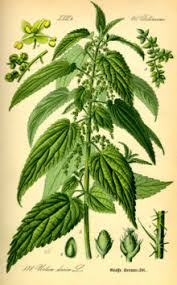
If you get stung by these nettles you will generally find Dock leaves near by. You take a leaf rub it over the sting and it minimises the pain if not completely rids you of it.

Nettles have long be known to provide a rich source of iron and Nettle Soup can be made very easily.
Medicinal Uses of the Nettle Parts employed: The whole herb, collected in Mayand June, just before coming into flower, and dried in the usual manner prescribed for 'bunched' herbs.
When the herb is collected for drying, it should be gathered only on a fine day, in the morning, when the sun has dried off the dew. Cut off just above the root, rejecting any stained or insect-eaten leaves, and tie in bunches, about six to ten in a bunch, spread out fan wise, so that the air can penetrate freely to all parts.
Hang the bunches over strings. If dried in the open, keep them in half-shade and bring indoors before there is any risk of damp from dew or rain. If dried indoors, hang up in a sunny room, and failing sun, in a well-ventilated room by artificial heat. Care must be taken that the window be left open by day so that there is a free current of air and the moisture-laden, warm air may escape. The bunches should be of uniform size and length, to facilitate packing when dry, and when quite dry and crisp must be packed away at once in airtight boxes or tins, otherwise moisture will be reabsorbed from the air.
The seeds and flowers are dried in the sun, or over a stove, on sheets of paper.
The Nettle is still in demand by wholesale herbalists, who stock the dried and powdered herb, also the seeds. Homoeopathic chemists, in addition, employ the green herb for the preparation of a tincture.
Action and Uses
Although not prescribed by the British Pharmacopceia, the Nettle has still a reputation in herbal medicine, and is regarded in homoeopathy as a useful remedy. Preparations of the herb have astringent properties and act also as a stimulating tonic.
Nettle is anti-asthmatic: the juice of the roots or leaves, mixed with honey or sugar, will relieve bronchial and asthmatic troubles and the dried leaves, burnt and inhaled, will have the same effect. The seeds have also been used in consumption, the infusion of herb or seeds being taken in wineglassful doses. The seeds and flowers used to be given in wine as a remedy for ague. The powdered seeds have been considered a cure for goitre and efficacious in reducing excessive corpulency.
In old Herbals the seeds, taken inwardly, were recommended for the stings or bites of venomous creatures and mad dogs, and as an antidote to poisoning by Hemlock, Henbane and Nightshade.
An efficient Hair Tonic can be prepared from the Nettle: Simmer a handful of young Nettles in a quart of water for 2 hours, strain and bottle when cold. Well saturate the scalp with the lotion every other night. This prevents the hair falling and renders it soft and glossy.
| A good Nettle Hair Lotion is also prepared by boiling the entire plant in vinegar and water, straining and adding Eau de Cologne. |
For stimulating hair growth, the old herbalists recommended combing the hair daily with expressed Nettle juice.
The homoeopathic tincture of Nettle is made of 2 OZ. of the herb to 1 pint of proof spirit.
The powder of the dried herb is administered in doses of 5 to 10 grains.
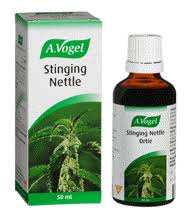
Preparations
Fluid extract of herb, 1/2 to 1 drachm. Infusion, 1 OZ. of the herb to a pint of boiling water.
Nettle Soup
- In a large pot, melt 1 Tbsp. butter over medium-high heat. Add onion and 1 tsp. salt. Cook, stirring occasionally, until onions are soft, about 3 minutes.
- Add potatoes and broth and bring to a boil. Reduce heat to maintain a steady simmer and cook 15 minutes.
- Add nettles and cook until very tender, about 10 minutes. Stir in remaining 1 Tbsp. butter, pepper, and nutmeg.
- Puree soup with an immersion blender or in a blender or food processer in batches. For a silken, less fibrous texture, run mixture through a food mill or sieve.
- Stir in cream, if using. Season to taste with additional salt and pepper, if you like.
- Serve hot, garnished with sour cream, yoghurt if you like.
|
Use glove when picking or you will be stung.
Fill the pot, the Nettles will shrink down.
Mix well. Starting to look more like soup, now.
Look's delicious now doesn't it? :-)
|
Nettle Tea- Very good for period pain, also full of Iron naturally.
Hope you all enjoyed the read. As always Stay Safe and we look forward to hearing from you. |
|
|
|

No comments:
Post a Comment